


Graphic novel targets Native representation with children’s book
April 20th, 2023 | SIT Graduate Institute
By Kelly Mulcaire, UM News Service
This article is reprinted with permission from the website. Natalie Peeterse is an alumna of SIT.
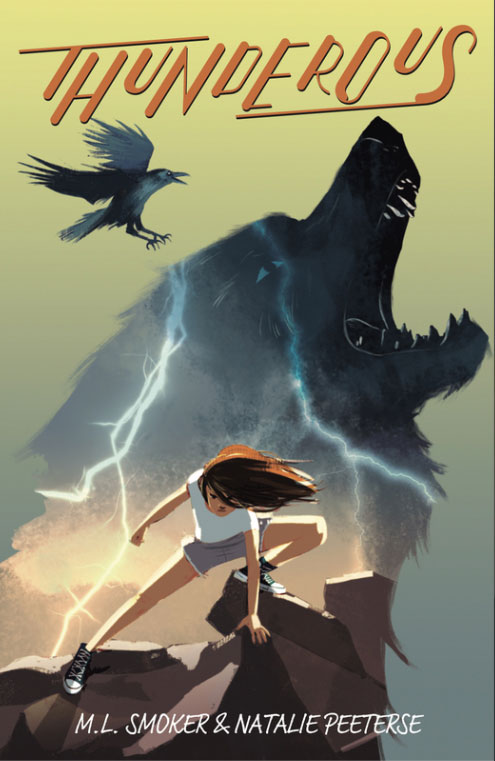
MISSOULA – Discussing their graphic novel, “Thunderous,” University of Montana alumni and authors Mandy Smoker Broaddus and Natalie Peeterse often share a troubling statistic: Native American stories make up only about 1 percent of children’s literature. That percentage becomes even smaller for books by Native authors or illustrators.
The talented duo is working to help change that reality through “Thunderous,” which is centered around a young Lakota woman named Aiyana, who is more interested in fitting in and growing her social media following than connecting with her Lakota heritage. The graphic novel format tells her story and the long-held Lakota traditions of helping others through text and comic-style art.

Smoker Broaddus, who also writes under the name M.L. Smoker, is a member of the Assiniboine and Sioux tribes of the Fort Peck Reservation, where she was born. She moved to California at a young age and attended Pepperdine University for her undergraduate degree. Peeterse, who is not Native, had a nomadic childhood as part of a military family, eventually attending high school in Germany. She completed her undergraduate studies at the 91¾«Ʒ.
Both women attended UM to earn a Master of Fine Arts in poetry. It was the second master’s degree for Smoker Broaddus, who previously earned a degree in Native American studies from UCLA.
The pair became academic cohorts and close friends. They now live in the same neighborhood in Helena, and their children are around the same age.
When Smoker Broaddus was approached by her friend Mato Standing High with the idea of creating a graphic novel focused on an indigenous character, she quickly brought Peeterse into the project.
“It seemed like something fun and interesting to do together,” said Smoker Broaddus.
Neither had worked on a graphic novel before. They began by brainstorming ideas and laying out character development and story arcs. They consulted their children to ensure they were using accurate lingo.
Less than halfway through the writing process, they sent their work to illustrator Dale Deforest, who is Navajo. He brought their story to life through his drawings. “His artistry is just magnificent,” Smoker Broaddus said.
Smoker Broaddus is Lakota and knew she wanted to build a modern story centered around traditional Lakota values.
“One of the most important things to me is that young audiences see a contemporary Native story and they think, ‘Native people are still here in our communities and are contributing,’” she said.
The authors did extensive research into Lakota culture and oral histories to craft Aiyana’s story. Peeterse hopes readers will connect with those themes in the way she did while writing.
“When you read the book, you walk away understanding that we have a lot to learn from Lakota culture about how to treat one another and how to be in the world in terms of relating to other people,” she said.
The project was an opportunity for Smoker Broaddus to use her writing talents while serving others.
“I knew I wanted to write, but I knew I also wanted to help my community,” she explained, “so I told myself first go for an advanced degree you can hopefully use to be of service, and then if that goes well, you can go for the one that is more for you. And that was the MFA.”
For Peeterse, the MFA program was a chance to hone in on her passion for writing.
“I decided I wanted to pursue poetry,” she said. “I had been writing my whole life, but I didn’t go to undergrad for literature or writing.”
Studying at UM offered Smoker Broaddus the opportunity to return to her home state and connect with a Native literary community. James Welch, a lifelong influence, had studied at UM, and Debra Earling was on the faculty.
Peeterse had been considering several programs but was steered toward the Treasure State. “I was thinking about going to a couple of other places but then people asked ‘Have you ever been to Missoula, Montana? It’s the best place in the world.’”
Both Smoker Broaddus and Peeterse credit their time at UM as opening up their perspectives as poets.
“I was exposed to a lot of contemporary American poets and poetry that I hadn’t been aware of,” Peeterse said. “I think when you do any art it’s good to learn about what came before you.”
“You’re exploring your own creative voice and creative talent, and you’re also being exposed to a whole world of writers that you might not have ever experienced before,” Smoker Broaddus added. “Those different backgrounds, orientations, perspectives – that’s all made me not just a better writer, but a better person.”
The Montana Arts Council awarded a grant to distribute “Thunderous” to Montana students. A lesson plan is in the works to help teachers bring the graphic novel into the classroom.
“We’ve had teachers from New England and Alaska and the Southwest all talk about teaching it,” Smoker Broaddus said. “We hope that kids ask questions while engaging with the story.”
The graphic novel format seems to have made a positive impression on the two poets, who are planning another story aimed at a slightly older age group.
“I’d like to give it another go now that I know what I’m doing,” Peeterse said. “Getting these kinds of stories out there is really important. Having the opportunity to be part of that mission is really exciting.”
“Thunderous” is now available in local bookshops across Montana.